If your 65th birthday is three months away, this turning 65 checklist tells you exactly what to handle before your Medicare window closes. The Initial Enrollment Period runs seven months total, but starting your turning 65 checklist now, while you still have time to compare plans and gather paperwork, gives you the most coverage options and the lowest risk of a lifelong penalty.
Every year, thousands of people wait too long to start their checklist for turning 65 and end up paying more for the rest of their lives, simply because a deadline passed while they were still deciding. A little planning now avoids that outcome entirely, and it takes less time than most people expect.
Why a Turning 65 Checklist Matters 3 Months Before Your Birthday
Medicare’s Initial Enrolment Period (IEP) is a seven month window built around your 65th birthday. It opens three months before your birthday month, includes your birthday month, and closes three months after. If you enroll during the first three months, Part B coverage starts the month you turn 65, with no gap in care.
This is why a turning 65 checklist built around the three month mark works so well: it lines up with the point where you get the earliest possible coverage start date. You still have time to compare plans, gather paperwork, and think through your budget before anything is locked in. Miss the window entirely and Part B premiums rise 10% for every 12 month period you go without coverage, and that penalty follows you for as long as you have Medicare.
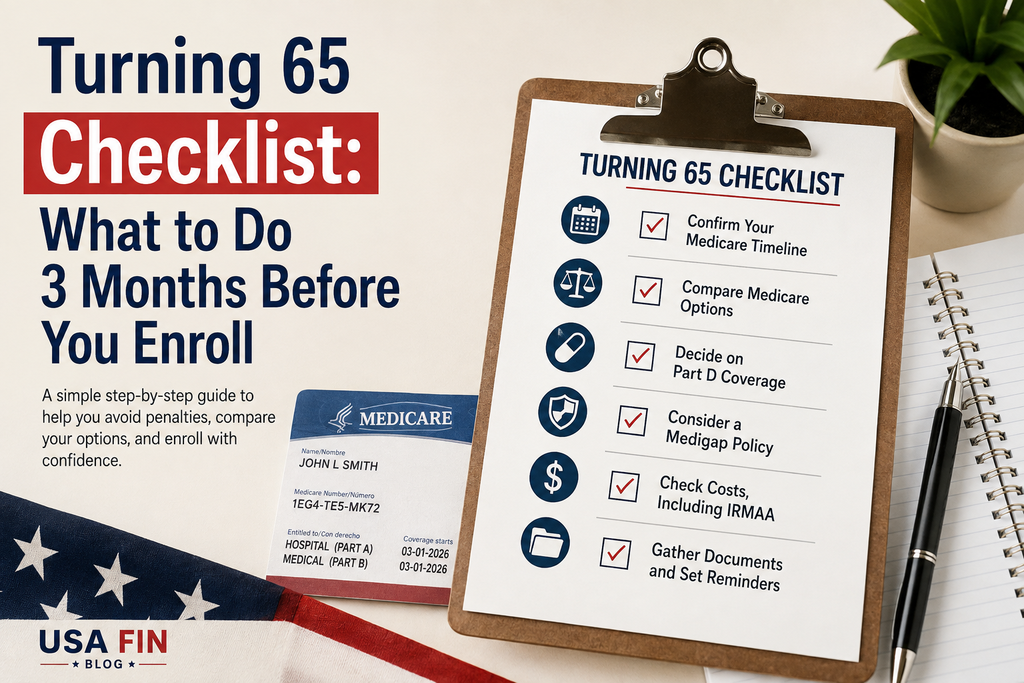
Turning 65 Checklist Step 1: Confirm Your Medicare Enrollment Timeline
The first item on any turning 65 checklist is confirming your exact dates, because everything else depends on getting this right. If you already receive Social Security benefits, you’ll likely be enrolled automatically in Parts A and B, and your Medicare card should arrive by mail a few months before your birthday. If not, you need to apply yourself at ssa.gov, by phone, or in person at a local Social Security office.
Write down the day your IEP opens, your birthday month, and the day the window closes. This single step keeps the rest of your 65 checklist on track, since every later decision, from Part D to Medigap, has its own clock that starts ticking from these same dates.
Turning 65 Checklist Step 2: Compare Original Medicare and Medicare Advantage
Next on your turning 65 checklist: decide between Original Medicare (Parts A and B) and a Medicare Advantage plan (Part C). Original Medicare pairs with a separate Part D drug plan and, often, a Medigap policy to cover what Medicare leaves unpaid. Medicare Advantage typically bundles medical and drug coverage into one plan, usually built around a regional provider network.
Neither option is universally better than the other. Your checklist for turning 65 should include a comparison of your preferred doctors and hospitals, your current prescriptions, and how often you travel or split time between states, since Medicare Advantage networks are usually regional while Original Medicare is accepted nationwide. If you value predictable, capped out-of-pocket costs over network flexibility, that preference should shape which path you take. This part of your turning 65 checklist is worth revisiting once a year, since plan networks and drug formularies can change.
Sample 3-Month Turning 65 Checklist Timeline
| Months before 65th birthday | Task |
|---|---|
| 3 months out | Confirm IEP dates and request your Medicare card if you’re auto-enrolled |
| 2 months out | Compare Original Medicare versus Medicare Advantage plans in your area |
| 1 month out | Choose a Part D plan or confirm you have other creditable drug coverage |
| Birthday month | Enroll if coverage isn’t automatic, and confirm your effective date |
Keeping a month-by-month turning 65 checklist like this one prevents last-minute scrambling and gives you a built-in deadline for each decision, rather than trying to handle everything in the final week.
Turning 65 Checklist Step 3: Decide on Part D Drug Coverage
Even if you take no medications today, your turning 65 checklist should still include a Part D decision, because the penalty for skipping it is based on time, not usage. Going 63 or more consecutive days without creditable drug coverage after your IEP ends triggers a permanent penalty of roughly 1% of the national base beneficiary premium for every month you went uncovered.
In 2026, that base premium is $38.99, so the penalty adds up faster than most people expect, and it compounds every year the base premium increases. This is one of the most overlooked items on a 65 checklist, so don’t skip it even if you feel perfectly healthy right now. If you’re still covered through an employer plan, confirm in writing that it counts as creditable coverage, and keep that letter somewhere safe.
Turning 65 Checklist Step 4: Consider a Medigap Policy
If Original Medicare is your choice, your turning 65 checklist should include Medigap. These supplemental policies help cover the deductibles, copayments, and coinsurance that Original Medicare leaves unpaid, which can otherwise add up quickly if you need frequent care. Your Medigap Open Enrollment Period begins the first day of the month you’re both 65 and enrolled in Part B, and it only lasts six months, so timing again matters.
Buying Medigap during this specific window means insurers can’t deny you coverage or charge more because of pre-existing conditions. Missing this piece of your checklist for turning 65 can mean permanently higher premiums, or being turned away for coverage later, when your health may have changed. Add the Medigap deadline to your turning 65 checklist as its own line item, separate from the IEP dates, since the two windows don’t always line up.
Turning 65 Checklist Step 5: Check Your Costs, Including IRMAA
The last financial piece of your turning 65 checklist is understanding your premiums before they hit your bank account or Social Security check. In 2026, standard Part B costs $202.90 a month with a $283 annual deductible. Part A is premium free for most people who worked at least 40 quarters, but it carries a $1,736 hospital deductible per benefit period, which is separate from Part B costs.
If your income is above $109,000 for an individual or $218,000 for a married couple filing jointly, you’ll pay an Income-Related Monthly Adjustment Amount, or IRMAA, on top of standard premiums. IRMAA is based on your tax return from two years earlier, so a high-income year right before retirement can raise your first Medicare bills more than expected. Run your own turning 65 checklist numbers with our Medicare Cost Calculator to see what your actual monthly premium is likely to be, based on your own income and filing status.
Turning 65 Checklist Step 6: Gather Documents and Set Reminders
The final stage of your turning 65 checklist is administrative, and it’s the part people put off longest. Locate your Social Security number, proof of any employer coverage, and your birth certificate or passport if you’re applying manually rather than being auto-enrolled. Keep digital or paper copies together in one folder so nothing gets lost between now and your birthday month.
A checklist for turning 65 is only useful if you actually follow it. Put reminders on your phone now, three months out, for each key date: when your window opens, the midpoint, and the final deadline. That way the decisions above get made calmly, one at a time, instead of all at once under pressure, and your turning 65 checklist stays a short list of tasks rather than a source of stress.
Bottom Line: Your Turning 65 Checklist
Starting your turning 65 checklist three months before your birthday gives you the full seven month Initial Enrollment Period to compare plans, confirm costs, and avoid penalties that follow you for life. Work through each step in order, confirm your dates first, and don’t wait until the last minute to make decisions that are much easier to get right early.
This is for informational purposes only and isn’t financial, tax, or legal advice.

Raghu Shekar writes about personal finance, banking, Medicare, and retirement planning at SimpleUSAFinance. His goal is simple: break down the numbers people actually need — no jargon, no sales pitch — so readers can make their own decisions with confidence. When he’s not writing, he’s usually digging through the latest rate changes, tax brackets, or Medicare updates to keep the site’s calculators and guides current.